The medical device industry is undergoing a fundamental shift in where and how care is delivered. Pressure to reduce healthcare costs, lighten hospital workloads, and improve patient outcomes is accelerating the move from clinical settings to the home – and device architectures must follow.
Three converging trends define this transition: first, the migration from hospital to home, where devices must be portable and intuitive enough for patients to use independently; second, the shift from reactive to continuous monitoring, with near-patient diagnostics enabling earlier intervention before conditions escalate; and third, the move from standalone components to integrated systems, where more sensing and actuation capability must fit within smaller, wearable form factors. Together, these trends place new demands on the fundamental materials and components that OEMs build into their devices.
Patients expect devices that are quiet, compact, and comfortable – yet most OEM engineering teams are still building with rigid motors, discrete sensors, and separate sealing components that work against those expectations. Each additional part means another assembly step and another constraint on how small or silent a device can become.
Datwyler has spent over a century developing high-performance elastomer materials for system-critical applications, and that materials expertise is now driving a new category of soft sensor and actuator technology. Developed in-house and in partnership with leading research institutes, these solutions address recurring key pain points that medical device engineers encounter when designing next-generation diagnostic and monitoring devices.
Why Does Noise and Vibration Matter in Medical Device Design?
Traditional actuators rely on motors and gears that generate mechanical noise and vibration. In clinical and home-care settings alike, that noise affects patient comfort, disrupts diagnostic accuracy for devices that capture physiological signals, and can even interfere with the device’s own sensing capability.
Datwyler’s soft actuator technology uses electroactive polymer materials that convert electrical input directly into mechanical motion, without the motor components that produce audible noise.
How Can OEMs Reduce Device Size Without Sacrificing Function?
Bulky architectures are often a direct consequence of combining separate motors, sensors, and housings into a single device. Each discrete component requires its own enclosure, wiring, and mounting hardware, and the cumulative volume of these parts limits how compact a finished device can be. Our soft actuators are built from thin, flexible polymer films that integrate sensing and actuation functions within a single material layer.
Design engineers gain more freedom to shrink device housings or redirect reclaimed space toward batteries, electronics, or additional functionality. We work directly with OEM engineering teams during solution design to identify where these soft components can replace multi-part subassemblies within a specific device architecture.
Can Hard Components Really Be Replaced With Conformable Materials?
Rigid sensors and actuators do not conform well to the curved, irregular surfaces of skin, soft tissue, or flexible surgical tools. This mismatch can cause discomfort, reduce signal quality in wearable monitoring devices, and limit the design of instruments intended for minimally invasive applications.
Our soft material platforms are designed specifically to conform to these dynamic, curved surfaces. SoftPulse®, our gel-free, skin-friendly electrode built from flexible conductive polymer, enabling continuous bio-signal monitoring without the irritation or signal degradation common to rigid electrode designs.
Magnetically Active Polymer Sensors
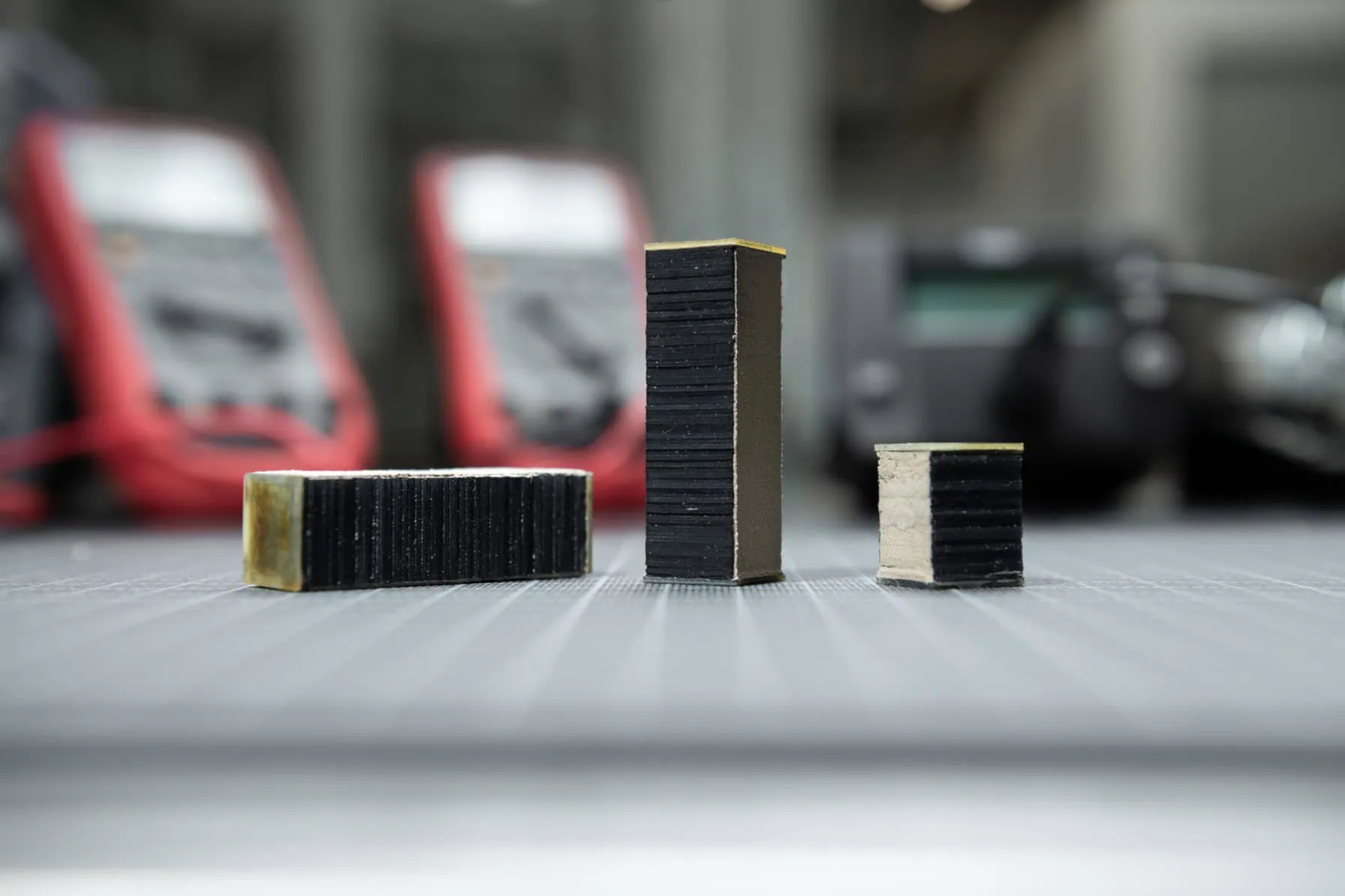
Force feedback is an increasingly important capability in advanced technological systems, including medical and other precision-driven technologies. Reliable force sensing supports accurate control, enhanced performance, and improved interaction in demanding applications.
Datwyler produces soft sensors that detect force, pressure, and displacement across multiple axes simultaneously – without the rigid load cells, discrete wiring, or complex mechanical assemblies that conventional force sensing requires.
This approach enables seamless integration into compact and delicate systems, maximizing space efficiency and durability while preserving design flexibility.
Partner With Our Engineering Team on Your Next Device Architecture
Datwyler’s solution design capability is built on early engineering collaboration – working alongside OEM teams from initial concept through to industrialization to define the most suitable integration approach for each device architecture.
We bring together material expertise, application engineering, and regulatory awareness to help our partners evaluate integration pathways, reduce development risk, and move from design intent to validated component. Visit our website to learn more about our innovation. Contact our engineering team to discuss your device requirements.